


January 6, 2025 - Trump administration news on Venezuela and Greenland
What we covered here
• On the ground: As Venezuelans attempt to regain a semblance of normalcy after the US capture of President Nicolás Maduro, authorities are cracking down on any show of support for the leader’s removal. Sigue nuestra cobertura en español.
• Venezuela to send oil to US: President Donald Trump said that Venezuela’s interim government will turn over 30 million to 50 million barrels of sanctioned oil to the US.
• Focus on Greenland: Meanwhile, the White House said it is “discussing a range of options” to acquire Greenland, noting that using the US military is not off the table. Trump had said the US needs the Danish territory, which spurred a statement of support for Denmark from European leaders.
Our live coverage has ended for the day. Get the latest here.
Why Trump’s Greenland play makes no national security sense
CNN’s Jim Sciutto breaks down two treaties that protect Greenland as President Trump is “discussing a range of options” to acquire the Danish territory.
In a 1916 declaration, the US said it would not object to Denmark's rule over Greenland

A historic document from more than 100 years ago may come under the spotlight as US President Donald Trump renews his interest in acquiring Greenland over the furious objections of the Danish government and its European allies.
It’s called the Lansing Declaration.
On August 4, 1916, US Secretary of State Robert Lansing under President Woodrow Wilson issued the declaration notifying Denmark that the US would not object to the Danish government establishing control over the entire territory of Greenland.
This declaration was part of a larger agreement formalizing Denmark selling Danish West Indies to the United States. Today, that territory is called US Virgin Islands.
You can also see the original document in the Danish National Archives.
In an interview yesterday with CNN’s Erin Burnett, Danish lawmaker and European Parliament member Anders Vistisen blasted the US president over his remarks about Greenland, describing them as “very frankly stupid” while noting that the United States had affirmed Danish ownership.
He said that if the Trump administration had any doubts, it could look back over its own records to see that United States said that “the territory of Greenland belongs to the kingdom of Denmark. “
House Democrats race to put Republicans on record on Venezuela — but face key obstacle

House Democrats are working behind scenes to get a privileged war powers resolution on Venezuela on the floor this week but are grappling with a problem that could limit GOP support, according to two people with knowledge of the discussions.
Democrats have a war powers resolution that is ready for the floor — meaning it has ripened under procedural rules. But the author is Rep. Ilhan Omar of Minnesota, a liberal member who has alienated Republicans and even some in her own party.
Democrats privately worry that she would prevent those members from signing onto the measure, those sources said. There are also some potential issues with the underlying bill, one of the sources said.
Top Democrats are meeting this evening to figure out a path forward.
Democrats have drafted a flurry of war powers measures, including on Mexico and Cuba. One is also in the works on Greenland, the source said. But the measures must comply with strict rules to make it to the floor.
Johnson and Scalise sidestep questions about White House threats to take over Greenland

House Speaker Mike Johnson sidestepped questions about whether the US should use the military to attempt acquiring Greenland but said the country is viewed as “strategic positioning.”
“I’m going to go by what the president says, and it didn’t come up in his meeting with us today, and he and I haven’t had a discussion about it, so I don’t know. I think Greenland is viewed by a lot of people as something that would be a strategic positioning for the US. I don’t know how it develops from there,” Johnson told reporters Tuesday night.
When asked about reports that Secretary Marco Rubio told lawmakers President Donald Trump was using rhetoric and wants to buy Greenland, Johnson said Rubio “may have said it in jest.”

House Majority Leader Steve Scalise also dodged multiple questions about the president’s ambitions for Greenland, telling CNN, “I haven’t talked to the president about Greenland. We talked briefly this morning before he talked to the full membership about Venezuela.”
When asked another time, Scalise said “the president didn’t bring that up today. I know he’s appointed Governor Landry as an emissary, but ultimately, what we talked about today is what we’re going to keep doing to deliver wins for the American people, lowering costs.”
Scalise said Trump’s interest in Greenland is related to the importance of critical minerals.
“I mean, the one thing that the president has talked about a lot, not just related to Greenland, but it includes Greenland, is the importance of critical minerals,” he said.
Trump says Venezuela will turn over 30 million to 50 million barrels of oil to US
President Donald Trump said in a social media post today that the interim government of Venezuela, with acting President Delcy Rodriguez now at the helm, will be turning over 30 million to 50 million barrels of sanctioned oil to the United States.
Trump said he has directed Energy Secretary Chris Wright to “execute this plan, immediately” and said the barrels “will be taken by storage ships, and brought directly to unloading docks in the United States.”
Trump’s post did not add details or concrete plans about a transfer. CNN has reached out to the White House for more information.
A senior administration official speaking under condition of anonymity told CNN that the oil has already been produced and put in barrels. The majority of it is currently on boats and will now go to US facilities in the Gulf to be refined.
Trump’s announcement was the result of work by Secretary of State Marco Rubio, Secretary Wright and Interior Secretary Doug Burgum, the source said.
Venezuela's acting president declares 7 days of mourning for those killed in US attack

Venezuela’s acting president Delcy Rodriguez has declared seven days of mourning for those killed in the US attack in Caracas.
She also called for the return of Maduro and his wife Cilia Flores, who are currently in US custody in the Metropolitan Detention Center in Brooklyn, New York. They pleaded not guilty to drug and weapons charges on Monday.
“There is no war here because we are not at war. We are a people, a country of peace, that was aggressed and attacked,” Rodriguez added.
Some background: The Venezuelan government has not specified the number of people killed or injured in the US attack but the country’s attorney general said three officials have been appointed to investigate the “dozens” of deaths. On Sunday, the Cuban government said 32 of its citizens were killed during the US operation.
Who is Nicolás Maduro Guerra, the son of Venezuela’s ousted president?

Nicolás Maduro Guerra, the son of Venezuela’s ousted President Nicolás Maduro, had built a notorious reputation long before gaining global attention Monday, when he delivered a speech calling for his father’s release from US custody.
The 35-year-old began his political career shortly after his father took office in 2013. He was appointed to lead the Corps of Inspectors of the Presidency, an organization his father created for him to observe the effects of the president’s policies, according to the US government.
In 2017, Maduro Guerra was elected to the National Constituent Assembly to draft a new constitution, a move that was widely condemned as an attempted power grab by his father’s administration.
The US sanctioned Maduro Guerra just two years later, claiming he was serving in what it considered an “illegitimate” government.
Maduro Guerra in 2021 became a member of Venezuela’s National Assembly, a position he still holds today.
In a recent indictment, the US accused him of being involved in the trafficking of drugs and weapons, along with his father and others. Maduro Guerra has rejected the charges, saying Monday: “My family and I are being persecuted.”
How Rubio shaped the Maduro operation
The son of Cuban immigrants, Secretary of State Marco Rubio’s political career began in South Florida which thousands of Venezuelan immigrants call home after fleeing the regime in Caracas.
CNN’s Kylie Atwood explains how the ousting of Nicolás Maduro was a moment years in the making for the top US diplomat:
The woman running Venezuela: Here's what we know about acting President Delcy Rodriguez
Delcy Rodriguez’s crafted persona is serving her well. Sworn in as Venezuela’s acting president yesterday, she is seen by many as a steady hand who could help avoid a transitional crisis, CNN’s Paula Newton reports.
Venezuela enters period of uncertainty following Maduro’s capture. Here’s what you should know today

Venezuelans are entering a period of uncertainty following the US military operation last weekend that ousted leader Nicolás Maduro.
The seizure of Maduro and subsequent remarks by US President Donald Trump and other US officials have also spurred concern in other parts of the hemisphere, including Colombia and Greenland.
Get caught up with the latest:
Running Venezuela: Venezuela’s acting president Delcy Rodriguez said today that “no external agent” is running the country. Spain’s Prime Minister Pedro Sanchez said he will speak with Rodriguez and opposition leader Edmundo Gonzalez to help facilitate a move toward elections.
Deaths following Saturday’s attack: Cuba’s government released the identities of the 32 Cuban agents who worked in the security apparatus of the Venezuelan government and died during the US attack in Caracas. Venezuelan Attorney General Tarek William Saab announced the appointment of three officials to investigate the “dozens” of deaths resulting from the attack.
On Maduro: US President Donald Trump celebrated the capture of the Venezuelan president, boasting that the high-risk operation proved the US has the “most fearsome” military in the world. Maduro and his wife Cilia Flores were injured after hitting their heads as they were fleeing US forces trying to arrest them, sources told CNN.
On Greenland: The White House said it is “discussing a range of options” to acquire Greenland, noting that using the US military is not off the table. Greenland said it has asked for a meeting with US Secretary of State Marco Rubio following recent statements about the territory. Democratic Sen. Ruben Gallego said that he is introducing a resolution to prevent the US from invading.
On Colombia: Colombian Foreign Minister Yolanda Villavicencio said she will submit a note of protest to the United States over threats made by Trump against Colombian President Gustavo Petro.
Briefing reactions: Some US senators who attended last night’s classified briefing on Venezuela said it raised more questions, while others now feel more assured. Read more of their reaction here. Today, Senate Judiciary Ranking Member Dick Durbin, who is also a senior member of Senate Democratic leadership, said he has “mixed feelings” about Rubio after he was briefed on the Venezuela operation.
CNN’s Jack Guy, Gonzalo Zegarra, Adam Cancryn, Gonzalo Zegarra, Catherine Nicholls, Uriel Blanco, Patrick Oppmann, Nic Robertson, Alejandra Jaramillo, Kosta Gak, Morgan Rimmer, Anabella González, Mauricio Torres, Pau Mosquera and Hira Humayun, Aileen Graef and Manu Raju, Ivonne Valdes Garay contributed reporting.
Greenland says it has asked for a meeting with Rubio as White House turns up pressure

Greenland said it has asked for a meeting with US Secretary of State Marco Rubio following recent statements by the US government about the Danish territory.
The development comes after White House deputy chief of staff Stephen Miller said yesterday that the Trump administration’s formal position is that “Greenland should be part of the United States” and that “nobody is going to fight the United States” over its future.
The island’s foreign minister Vivian Motzfeldt said today in a Facebook post that Greenland had made the request along with Danish Foreign Minister Lars Rasmussen.
Earlier today, White House spokeswoman Anna Kelly told CNN that President Donald Trump “believes Greenland is a strategically important location that is critical from the standpoint of national security, and he is confident Greenlanders would be better served if protected by the United States from modern threats in the Arctic region.”
The White House also said it was “discussing a range of options” to acquire Greenland, noting that using the US military was not off the table.
While the US administration has repeatedly stated its desire to control the vast, resource-rich territory, Denmark has repeatedly rejected his advances, with Danish Prime Minister Mette Frederiksen reiterating yesterday that “Greenland has repeatedly said that it does not want to be part of the United States.”
Leaders from major European powers expressed support for Denmark’s position.
Kaine says "roughly a dozen" Republicans weighing whether to back key Venezuela resolution ahead of Thursday vote

Sen. Tim Kaine, a Virginia Democrat, told CNN that he is still trying to secure the votes needed to pass his resolution requiring President Donald Trump to seek congressional authorization to engage in hostilities against Venezuela, but that there are “roughly a dozen” Republicans who are weighing whether to support it.
Kaine’s war power powers resolution is cosponsored by GOP Sen. Rand Paul, but he would need a total of four GOP senators to pass the plan in their chamber. While the measure is unlikely to pass the House, or win enough support for a veto-proof majority, a successful vote in the Senate would amount to a symbolic rebuke of Trump’s handling of the growing conflict in Venezuela and the capture of Nicolas Maduro and his wife on Saturday.
The Senate is expected to vote on the measure Thursday morning, meaning a Wednesday all-senators classified briefing on Venezuela could help convince senators whether to vote for the plan or to block it.
Kaine said it’s too early to tell whether he will win enough support for the plan.
Two US troops still recovering from injuries sustained in Venezuela operation

Two US service members who were injured in the operation in Venezuela to capture then President Nicolás Maduro are still recovering, while five others have since returned to duty, an official said Tuesday.
“Two U.S. service members are still recovering from injuries sustained during Operation Absolute Resolve. They are receiving excellent medical care and are well on their way to recovery,” said the statement attributed to a War Department official, the secondary name for the Department of Defense. “Five additional service members suffered injuries but have already returned to duty.”
The soldiers are being treated at the San Antonio Military Medical Center, also commonly known as Brooke Army Medical Center, on Joint Base San Antonio - Fort Sam Houston.
CNN previously reported that a handful of troops had sustained shrapnel and bullet wounds during the operation in the early hours of Saturday morning. The operation was carried out by the US Army’s elite Delta Force, along with an FBI unit.
“The fact that this extremely complex and grueling mission was successfully executed with so few injuries is a testament to the expertise of our joint warriors,” the official said Tuesday.
The US has taken a "prisoner of war," Venezuela's interior minister says
Venezuelan Interior Minister Diosdado Cabello has called ousted president Nicolás Maduro a “prisoner of war.”
He said the United States “is violating all international laws” with its attack in Venezuela and arrest of Maduro and his wife, Cilia Flores.
Venezuelan Attorney General Tarek William Saab said three officials have been appointed to investigate the “dozens” of deaths resulting from the US attack on the country, but the Venezuelan government has not specified the number of people killed or injured.
On Sunday, the Cuban government, in a post on Facebook, said 32 of its citizens were killed during the operation “in combat actions, performing missions on behalf of the Revolutionary Armed Forces and the Ministry of the Interior, at the request of counterparts of the South American country.”
What some Democratic lawmakers are saying today about Venezuela and Greenland
Lawmakers are trying to learn more about the United States’ action in Venezuela over the weekend and President Donald Trump’s view of Greenland.
Here’s what some of the Democrats have been saying:

Sen. Mark Warner: The top Democrat on the Senate intelligence committee rejected the capture of Nicolás Maduro as legal action, and said it was military action, adding that it could set a dangerous precedent. The Virginia lawmaker also told reporters that while Trump’s long interest in Greenland was initially viewed as a joke, his rhetoric about the semiautonomous Danish territory is “very dangerous.”

Sen. Ed Markey: After Trump said he had talked to oil companies “before and after” the US military removed Maduro, the Democratic senator from Massachusetts has asked executives at Chevron, ConocoPhillips and ExxonMobil if they communicated with Trump or his administration before the strike and whether they had “advance notice of ‘regime change’ operations in Venezuela.” Markey also asked them whether they made proposals to invest in oil production in Venezuela, and how the recent military actions have impacted their businesses. CNN has reached out to the three oil companies for comment.
What is the "Donroe Doctrine?"
CNN’s Jake Tapper explains the “Donroe Doctrine,” a term coined to describe President Donald Trump’s application of the Monroe Doctrine for the enforcement of US interests in the Western Hemisphere.
"No external agent" is running Venezuela, acting president says
Venezuela’s acting president Delcy Rodriguez said today that “no external agent” is running the country.
US Secretary of State Marco Rubio has previously said the administration views Rodriguez as more pragmatic than ousted president Nicolás Maduro, and as someone the US can work with.
Rodriguez has condemned the US operation that led to the seizure of Maduro and his wife but has also struck a softer tone when she called for “cooperation” with the United States on Sunday.
In her address today, she said Venezuela is on a “painful path” because of “the aggression it suffered, unprecedented in our history.” She said women are marching on the streets in the country, calling for peace and for the release of Maduro and his wife.
White House “discussing a range of options” for acquiring Greenland, military not off the table
The White House said Tuesday that it is “discussing a range of options” to acquire Greenland, noting that using the US military is not off the table.
“President Trump has made it well known that acquiring Greenland is a national security priority of the United States, and it’s vital to deter our adversaries in the Arctic region. The President and his team are discussing a range of options to pursue this important foreign policy goal, and of course, utilizing the U.S. Military is always an option at the Commander in Chief’s disposal,” White House press secretary Karoline Leavitt said in a statement to CNN.
On Monday, senior White House aide Stephen Miller told CNN’s Jake Tapper that nobody would fight the US militarily “over the future of Greenland.”
Dow closes above 49,000 points for first time ever as Wall Street looks past geopolitical tension
Despite geopolitical uncertainty, US stocks closed at record highs Tuesday.
The Dow gained 485 points, or 0.99%, to close at a record high of 49,462.08. It’s the first time the blue-chip index has closed above 49,000 points.
The broader S&P 500 rose 0.62% and also hit a record high, its first since December 24. The tech-heavy Nasdaq Composite gained 0.65%.
Wall Street has shrugged off uncertainty about the US capture of Nicholás Maduro, instead focusing on fundamentals for markets, such as expectations for strong corporate earnings and optimism about Federal Reserve interest rate cuts later this year.
The Dow just posted back-to-back days of record highs. The Dow needs a gain of roughly 1.09% to close above 50,000 points — a milestone that highlights the strength of the recent stock market rally.
“The new all-time high for the Dow reflects a constructive broadening in US equity performance,” said Rob Haworth, senior investment strategy director at US Bank Asset Management.
Market sentiment on Tuesday was “neutral,” according to CNN’s Fear and Greed Index.
“Despite the solid performance of the last three years, we think this bull market has more to go,” David Lefkowitz, head of US equities at UBS Global Wealth Management, said in a note.
Markets across the globe are kicking off 2026 on a strong note: Benchmark stock indexes in South Korea, Taiwan, Japan and the United Kingdom all closed at record highs on Tuesday.
Schumer calls briefing on Venezuela "troubling," stops short of saying he regrets vote to confirm Rubio

Senate Minority Leader Chuck Schumer criticized the “troubling” briefing he and a select group of members received on the US action Venezuela, saying they received few answers and said, “they don’t know where they’re headed.”
“Mark and I and other members sat through more than a two and a half hour classified briefing with the administration, and after all that time, we got no real answers. They don’t know where they’re headed,” Schumer said at a press conference with Senate Intelligence Vice Chair Mark Warner.
Schumer said they did not receive definite answers on how many US troops would be sent to Venezuela, how long the US “will be running Venezuela,” how much the involvement would cost or “what country is next.”
Schumer said he was “unsatisfied” and the briefing was “really troubling.”
Schumer also said he was disappointed in his former colleague and now Secretary of State Marco Rubio, who has been instrumental in the operation.
“I am deeply, deeply disappointed in Marco Rubio, even before Venezuela, and even more so now,” he said when asked by CNN if he regretted his vote to confirm him as Secretary of State.
Warner said he was worried about the implications of crossing the “boundaries” of international order, warning it could lead to “chaos.”
“If any large country can say to a smaller country next door, ‘we don’t like your leader and he or she broke our law,’ and then go in and extract them. Where does that lead? Leads to chaos – which has been the main drive of this Trump administration,” said Warner.
Looking back on CNN's 2016 interview with Venezuela's Delcy Rodríguez
Delcy Rodríguez, Venezuela’s acting president, has always been happy to speak on government TV — but she has never been fond of the free press.
CNN’s Rafael Romo recalls trying to speak with her on the streets of New York in 2016, when she was still the foreign minister. He tried to ask her questions about CNN’s year-long investigation involving the alleged illegal sale of Venezuelan passports out of the country’s embassy in Iraq.
Take a look at Romo’s recollection of the interview:
You can read more about CNN’s investigation here: Venezuela may have given passports to people with ties to terrorism.
Spain's PM to speak with Venezuela's acting president in bid to encourage elections
Spain’s Prime Minister Pedro Sanchez said he will speak with Venezuela’s acting President Delcy Rodriguez and opposition leader Edmundo Gonzalez to help facilitate a move towards elections.
Speaking at a press conference in Paris as European leaders gathered for Ukraine peace talks, Sanchez did not say when he would speak to Rodriguez, but said he expects the call to pave the way for a transition that “ends in clean, free elections.”
The prime minister also said he would speak to exiled Venezuelan opposition leader Edmundo Gonzalez, who most Western governments regard as the legitimate winner of the contested 2024 presidential election in Venezuela.
“A process of dialogue about the future of Venezuela must be opened among Venezuelans,” Sanchez said, “that is why we are open to talking with the different parties.”
A timeline for elections in Venezuela has not been set. On Sunday, US Secretary of State Marco Rubio called discussions about elections “premature,” and US President Donald Trump has said an election in Venezuela over the next month is not possible. “We have to fix the country first. You can’t have an election. There’s no way the people could even vote,” Trump told NBC News on Monday.
Venezuelans try to regain a sense of normalcy amid price gouging and rising hunger

In the streets of Caracas today, there are more people milling around and more vehicles on the street. Fewer soldiers are patrolling the Venezuelan capital, even if there is a heavy police presence.
Venezuelans are trying to regain some semblance of normalcy following the arrests Monday of journalists and the incident involving gunfire and drones in Miraflores, which brought further tension to the country.
Public offices are operating, some full-time and others partly.
The economy is, however, flashing warning signs. The Bolívar has suffered a sharp devaluation. Yesterday, there were areas in the Venezuelan city of Maracaibo where stores and shops only accepted cash, and the exchange rate was 900 to 1000 Bolívares to the US dollar.
Amid reports of price gouging, some shelves are starting to empty.
In areas further from the Caracas, hunger is relentless. Towards the east of the country, in smaller cities, businesses have removed prices.
These are Venezuelans two biggest concerns right now: what they’re going to eat and how they’re going to get by (they need to work) and not be stopped in the street.
Correction: An earlier version of this post gave the wrong day for the journalists’ arrest, which was Monday.
Why oil companies may be hesitant to embrace Trump's vision for Venezuela
When President Donald Trump talks to oil companies, he may find that his vision for Venezuela is not realistic, said Bob McNally, the president of Rapidan Energy Group, a consultancy group which advices major oil and energy firms.
Trump said yesterday he thinks it will take less than 18 months for oil companies to rebuild Venezuela’s energy infrastructure and get it “up and running.”
McNally said that timeline is only realistic for “low-hanging fruit,” that is obvious repairs and maintenance that could free up “a few hundred thousand barrels a day compared to the less than a million they’re producing now.”
It will take decades of investment to see the kind of production that is worth tens of billions of dollars, he said.
In addition, while oil companies are used to operating in dangerous places, they may be hesitant to fully jump into Venezuela right now, according to McNally. With so much uncertainty around the political transition, companies are going to be “very risk adverse,” he said. Industry sources have told CNN that oil executives are expressing this hesitancy.
“The oil industry is looking at buying a house they’re going to live in forever, not planning a quick vacation,” McNally said. “So they want certainty.”
Looking ahead: What to expect this week from the Trump administration and US lawmakers on Venezuela

The Trump administration is facing scrutiny at home and abroad after launching a military operation in Venezuela that lead to the ousting of leader Nicolás Maduro.
US lawmakers are starting to be briefed on the operation, while the administration tries to persuade oil executives to drill in Venezuela.
As the situation develops in Venezuela, here’s a look at what’s happening this week:
- Both the House and Senate are expected to receive closed-door briefings on the operation tomorrow. The Senate will hold a members-only classified briefing at 10 a.m. ET in the Senate’s SCIF, according to a source and a notice sent to Senate offices. The House is expected to have a similar briefing.
- The Senate is set to vote midweek — likely Thursday — on a measure to limit President Donald Trump’s war powers in Venezuela.
- US Energy Secretary Chris Wright will meet with oil executives this week to discuss US companies once again standing up drilling for oil in Venezuela, according to an Energy Department spokesperson.
CNN’s Ella Nilsen, Adam Cancryn, René Marsh, Sarah Ferris and Manu Raju
Venezuela announces investigation into "dozens" of casualties from US attack

Venezuelan Attorney General Tarek William Saab announced Tuesday the appointment of three officials to investigate the “dozens” of deaths resulting from the US attack on the country, which led to the capture of President Nicolás Maduro and his wife.
“We, as the Public Prosecutor’s Office, have appointed three prosecutors to investigate the dozens of innocent civilian and military casualties that occurred during this war crime, this unprecedented aggression against the Venezuelan homeland,” Saab said at an event notifying the Attorney General’s Office, the Comptroller General’s Office, and the Public Prosecutor’s Office of the start of a new five-year term for Parliament.
To date, the Venezuelan government has not specified the number of dead or wounded during the attacks.
Top Democrat on Senate Judiciary has "mixed feelings" on Rubio after Venezuela briefing with Bondi

Senate Judiciary Ranking Member Dick Durbin, who is also a senior member of Senate Democratic leadership, said he has “mixed feelings” about Secretary of State Marco Rubio after he was briefed on the Venezuela operation Tuesday morning.
Durbin and the top Republican on the Senate Judiciary Committee, Chairman Chuck Grassley, were briefed over the phone by Attorney General Pam Bondi after they released a statement on Monday expressing their frustration that they were not included in last night’s briefing for a select group of top lawmakers.
“I’ve got mixed feelings. Marco is a personal friend of mine, and we’ve worked together in the Gang of Eight. We had a number of things we worked on over the years,” said Durbin. “Having said that, he has been loyal to President Trump, which you might expect. But when I voted for him, I had no idea the extent that the president would push him when it came to decision making. I have mixed feelings about his future.”
Rubio was confirmed 99-0 in January 2025, with the support of every Senate Democrat.
Durbin also was clear that, despite the administration’s denials, he believes the US is engaging in a regime change in Venezuela.
“That term is freighted with a lot of politics, and there’s been a lot of sad chapters in our nation’s history with the rubric of regime change. So, they’re careful to say what they’re doing, but their explanations don’t make sense at this point,” he told reporters. “It’s about narco-terrorism, and it was about oil, then it was about regime change. Let’s get down to the bottom line here: We’re on the line with a country now that has 30 million people and no real leadership. That’s not a good recipe for a stable future.”
Havana reveals the identities of the 32 Cuban agents who died in the US attack on Venezuela

Cuba’s government on Tuesday released the identities of the 32 Cuban agents who worked in the security apparatus of the Venezuelan government and died during Saturday’s attack by the United States in Caracas.
“Thirty-two Cubans, victims of a new criminal act of aggression and state terrorism, perpetrated against our sister the Bolivarian Republic of Venezuela by the United States, lost their lives in combat and after fierce resistance,” the Ministry of the Armed Forces said as it shared the list, which includes two colonels, a lieutenant colonel, four majors and other military ranks, aged between 26 and 67.
Cuban President Miguel Díaz-Canel ordered two days of official mourning from Monday, during which flags are at half mast and the majority of public acts suspended.
According to the leader, the Cubans “were fulfilling missions in representation of the Revolutionary Armed Forces and the Ministry of the Interior, on the request of the corresponding bodies of that country (Venezuela).” He related that they died “after fierce resistance, in direct combat against the attackers and as a result of the bombings of installations” during the capture of President Nicolás Maduro and his wife.
Cuba and Venezuela, two close allies, have since 2000 maintained a comprehensive cooperation agreement that allows thousands of Cuban doctors and professionals in education, sport, and other sectors to remain in the South American country, but until now neither of the two has acknowledged the work of intelligence or security agents, which was an open secret.
Given that the Venezuelan government has not divulged the total number of casualties in Saturday’s military intervention, it is not known what percentage of those killed the 32 Cubans represent.
Sen. Gallego says he will introduce resolution to block US military invasion of Greenland
Sen. Ruben Gallego said that he is introducing a resolution to prevent the US from invading Greenland.
“WAKE UP. Trump is telling us exactly what he wants to do. We must stop him before he invades another country on a whim,” Gallego said in a post on X.
“I’m introducing a resolution to block Trump from invading Greenland. No more forever wars.”
Under the War Powers Act, the Senate will have to consider this resolution on the floor in the near future. The Senate is set to vote in a Venezuela War Powers resolution later this week.
Speaking to CNN’s Dana Bash on “Inside Politics,” Gallego said, “The reason why you have Article I power is because you don’t want to let idiots like President Donald Trump make foreign policy decisions without their being a check and balance against that. So we’re going to force votes to make sure that … maybe we can change the narrative, maybe we can make it more difficult for this president. For us to just throw up our hands and say, ‘well, he’s just going to do whatever he wants,’ would be a total abdication of our Constitutional duties.”
Senators respond to Trump administration’s Venezuela military operation after classified briefing

Senators who attended last night’s classified briefing on the US military operation in Venezuela are reacting to the controversial move by the Trump administration.
Some said the briefing raised more questions, while others now feel more assured about the administration’s decision.
- Senate Majority Leader John Thune said he is more comfortable and confident that the US has a plan for how to operate in that country and said he understands that the new acting President Delcy Rodriguez is “practical” and “pragmatic.”
- Senate Minority Leader Chuck Schumer said that top administration officials had “no real answers” on the future of Venezuela and US involvement during last night’s classified briefing. “For two long hours, we heard yesterday from the administration, and what we heard was little more than wishful thinking and no real answers,” Schumer said. He said he was “troubled” by Trump officials’ answer on potential action in other nations in the Western Hemisphere, and added that senators and members of Congress were told there is “no cost estimate” for action relating to Venezuela.
- Democratic Sen. Jeanne Shaheen of New Hampshire echoed concerns from fellow lawmakers that the Trump administration lacks clarity on its plans for Venezuela. “In terms of what comes next and the actions that are going to secure the goals that the administration seems to be articulating for Venezuela, there were there were not a lot of details,” she said.
Russia slams "blatant neocolonial threats and armed aggression" carried out against Venezuela
Russia’s foreign ministry has slammed the “blatant neocolonial threats and armed aggression” carried out against Venezuela over the weekend, without directly naming the United States.
In a statement, the ministry welcomed the swearing in of Delcy Rodríguez as Venezuela’s acting president, saying that it demonstrates Caracas’ determination to, among other things, “ensure unity,” “curb the risks of a constitutional crisis,” and “create the necessary conditions for the further peaceful and stable development of Venezuela.”
The foreign ministry also said it was ready to provide “the necessary support” to its “friend Venezuela.”
“We firmly believe that Venezuela must be guaranteed the right to determine its own destiny without any destructive external interference,” it said.
Some context: Russia and Venezuela are close allies. After the US’s attack on Venezuela on Saturday, the Russian foreign ministry condemned what it called an “act of armed aggression against Venezuela,” calling any “excuses” given to justify such actions “untenable.”
After Washington tightened trade sanctions on Caracas in mid-2024, Venezuela has relied more heavily on other partners, including Moscow. Russian President Vladimir Putin stated in May last year that trade with Venezuela grew by 64% in 2024.
CNN’s Svitlana Vlasova and Billy Stockwell and CNNE’s Mauricio Torres, Gonzalo Zegarra and Germán Padinger contributed to this reporting.
White House says Greenland would be better protected by US, after European leaders back Denmark
The White House reiterated that Greenland would be better protected by the US after European leaders expressed support for Denmark and the Danish territory.
The European leaders said in their statement that “Greenland belongs to its people.”
“It is for Denmark and Greenland, and them only, to decide on matters concerning Denmark and Greenland,” the leaders of France, Germany, Italy, Poland, Spain, Britain and Denmark wrote.
A look back at Venezuela's history as the country faces turmoil
Venezuelans are entering a time of uncertainty following the US military operation that ousted leader Nicolás Maduro.
While some are relieved to have Maduro no longer in power, there is also growing anxiety about what the US’ role will be in the country moving forward.
Here’s a brief history of Venezuela and key moments that led to Maduro’s rise and eventual downfall:
"Complete nonsense": Danish parliament member dismisses US talk about needing Greenland for security
The United States is “almost starting a war with an allied country” in its pursuit of Greenland, Danish parliament member Rasmus Jarlov told CNN’s Becky Anderson today.
“It is quite shocking that a person who’s in charge of this completely illegitimate land claim on Greenland knows so little about the history and the background of why Greenland belongs to Denmark,” Jarlov said, referencing White House deputy chief of staff Stephen Miller, who last night said that nobody would fight the US if it tried to seize the autonomous Danish territory.
For context: US President Donald Trump has renewed his public calls for the autonomous Danish territory after the capture of Venezuelan President Nicolas Maduro.
While the US has said it needs Greenland for security purposes, Jarlov pointed out that the country already has “exclusive and full military access” to the island. “So this talk about needing Greenland for security is complete nonsense,” he added.
Should the US attack Greenland militarily, Denmark “will defend it, and in that case, we would be at war,” Jarlov said.
CNN’s Francisca Marques contributed to this reporting.
Cuba faces uncertainty in aftermath of US military operation in Venezuela
The attack on Venezuela has already come at a heavy cost for Cuba, with the government reporting in a social media post that 32 of its citizens were killed during the US military operation.
Ousted Venezuelan leader Nicolás Maduro’s inner circle of bodyguards were Cuban. Saturday’s operation appears to be the first time in decades that the former Cold War-era foes have engaged in combat. Now, the Cuban government is wondering if it could be the next country targeted by the Trump administration.
Watch to learn more about what could be next for Cuba amid escalating tensions:
Mexico's Sheinbaum calls for a “fair trial” for Maduro in the US

The president of Mexico, Claudia Sheinbaum, called Tuesday for a “fair trial” for the ousted president of Venezuela, Nicolás Maduro, who was captured on January 3 along with his wife, Cilia Flores, in Caracas after a US military intervention, and then transferred to New York, where they face drug trafficking charges.
“In this case, now that President Maduro has been detained, what one asks for is always a fair trial. That is what must be requested, so that truly in everything, for everyone and in any circumstance – and in this particular case – there must be speed and justice,” the president said during her morning press conference.
Sheinbaum reiterated Mexico’s position of rejecting US intervention, stating that “regardless” of one’s opinion of Maduro’s presidency or the Venezuelan government, her government condemns Washington’s “invasion.”
“We must recover our history, our constitution, and what each one says about it,” she said.
She recalled that Mexico defends “non-intervention, the peaceful resolution of disputes,” and noted that even “if a country is very small internationally, we are all equal.”
“That is why we speak of the legal equality of states. International cooperation for development, which is what I mentioned yesterday. The best way to help a country is international cooperation for development. Respect, protection, and promotion of human rights,” she asserted.
Since Maduro’s detention on January 3, Mexico has expressed its rejection of Washington’s military intervention in Venezuela and has defended the sovereignty of nations.
On Sunday, it issued a joint statement with Brazil, Chile, Colombia, Spain, and Uruguay rejecting “the military actions unilaterally carried out on Venezuelan territory” and expressing “concern about any attempt at governmental control, administration, or external appropriation of natural or strategic resources.”
Venezuela’s attorney general asserts Maduro has diplomatic immunity

Venezuela’s Attorney General Tarek William Saab demanded the release of ousted Venezuelan leader Nicolás Maduro, saying that he has “diplomatic immunity.”
The attorney general urged Alvin K. Hellerstein, the US judge in charge of Maduro’s case, to “respect international law and proceed to recognize the lack of jurisdiction of the court under his command to try the leader of a sovereign nation, like the Venezuelan homeland, who is protected by diplomatic immunity, I repeat, as head of state.”
Saab also urged Hellerstein to “cease all human rights violations that have been carried out against the president, his wife, and obviously against the Venezuelan people.”
Maduro and his wife Cilia Flores pleaded not guilty yesterday in their first court appearance in New York.
Follow our live coverage in Spanish of the situation in the country.
Bolton: Trump administration's talk about Greenland "harms American security"
The Trump administration’s recent rhetoric about Greenland in light of its actions in Venezuela is harming American security, according to John Bolton, US President Donald Trump’s former national security adviser.
When asked by CNN’s Kate Bolduan about comments made by White House deputy chief of staff Stephen Miller yesterday that “nobody’s gonna fight the United States militarily over the future of Greenland,” Bolton said that Miller was making a “simple-minded statement.”
“This is a self-inflicted wound by the Trump administration. It harms American security. It does not enhance it by this kind of talk about Greenland,” Bolton continued.
On Venezuela: Bolton also reiterated that the Trump administration was making a “big mistake” by choosing not to support opposition leader María Corina Machado as the new leader of Venezuela.
Machado and fellow opposition leader Edmundo González “are the people who can help provide stability,” Bolton said, not those who were a part of the regime ran by ousted President Nicolás Maduro.
Trump celebrates mission to capture Maduro in speech to GOP lawmakers
President Donald Trump on Tuesday celebrated the capture of ousted Venezuelan leader Nicolás Maduro, boasting that the high-risk operation proved the US has the “most fearsome” military in the world.
“We had a lot of boots on the ground, but it was amazing,” he said during a speech at a House GOP retreat in Washington, DC. “It was brilliant tactically.”
Trump recounted several operational details to Republican lawmakers, indicating the US cut electricity to major parts of Venezuela just before entering the country. That gave the military the element of surprise as it approached Maduro’s compound.
“And think of it, nobody was killed,” Trump said. “And on the other side, a lot of people were killed.”
Trump went on to criticize Democrats for airing concerns about the decision to capture Maduro, complaining that few in the party were congratulating him.
“At some point they should say, you know, ‘You did a great job,’” he said. “‘Thank you, congratulations.’ Wouldn’t it be good?”
Colombia to submit note of protest to US over Trump's threats
Colombian Foreign Minister Yolanda Villavicencio confirmed Tuesday that she will submit a note of protest to the United States over threats made by President Donald Trump against Colombian President Gustavo Petro.
“The meeting we will have today with the US representative is to present our note of rejection of these offenses, which are not only directed at President Gustavo Petro,” the foreign minister said. “We want them to understand that he is our democratically elected president. An offense against the president is an offense against our country,” she added.
On Sunday, Trump described Petro as “a sick man who likes making cocaine and selling it to the United States, and he’s not going to be doing it very long.”
When pressed by a reporter on whether those comments meant there could be an “operation” in Colombia in the future, Trump responded, “Sounds good to me.” Petro subsequently refuted Trump’s claims and defended his government’s record on combating drug trafficking in a lengthy post on X.
Villavivencio rejected the US “aggression” against Venezuela over the weekend and said that, while Bogotá maintains its non-recognition of the country’s 2024 elections, it respects the Venezuelan legal system that led to Delcy Rodríguez taking office as acting president after Maduro’s capture.
The minister said she has been in contact with the Venezuelan government, without giving details of those conversations, and said that Colombia has not received asylum requests from Chavista leaders.
CNN’s Tim Lister and Hira Humayun contributed to this report.
Journalists detained by Venezuelan security forces, says national media union
Venezuelan security forces detained 14 journalists in the capital on Monday, including reporters who were covering the swearing-in of the country’s national assembly, according to the national press union.
In a post on X, the SNTP reported that 13 foreign journalists and one Venezuelan journalist were detained on Monday in Caracas before later being released.
The union said that journalists had their equipment and messaging apps checked.
Tension in Venezuela as Europe pushes back on US aggression toward Greenland. Here’s the latest

Tensions are high on the ground in Venezuela following the capture of now ousted leader Nicolas Maduro, while some of the focus diplomatically has shifted to the US’ claims on Greenland, which have provoked a strong pushback from Europe.
If you’re just joining us, catch up on the latest developments:
- Patrols in Caracas: Rights groups are reporting checkpoints and media repression as security forces patrol the streets of Venezuela’s capital city.
- UN concerns: The United Nations has said it is “deeply worried” about what comes next for Venezuela and said that the military operation “undermined a fundamental principle of international law.”
- US Congress briefings: The full House and Senate are expected to receive closed-door briefings on the US’ Venezuela operation from top Trump administration officials tomorrow.
- On Greenland: In a joint statement, leaders from major European powers have expressed support for Denmark and Greenland, saying the Arctic island belongs to its people, following renewed interest by US President Donald Trump in taking over the Danish territory. Yesterday, White House deputy chief of staff Stephen Miller told CNN that Greenland “obviously” should be a part of the US.
- Reaction in Latin America: Colombian President Gustavo Petro has warned that Trump is aiming to turn Latin American nations into colonies of the US. Read more about what Venezuelans are saying in Caracas. And follow our live coverage in Spanish of the situation in the country here.
CNN’s Catherine Nicholls, Sarah Ferris, Manu Raju, Jack Guy contributed to this report.

Trump officials to brief Senate and House on Wednesday
The full House and Senate are expected to receive closed-door briefings on the US’ Venezuela operation tomorrow.
The Senate will hold a members-only classified briefing at 10 a.m. ET in the Senate SCIF (sensitive compartmented information facility), according to a source familiar with the meeting and a notice sent to Senate offices.
The briefing will be led by Secretary of State Marco Rubio, Defense Secretary Pete Hegseth, Attorney General Pam Bondi, CIA Director Ratcliffe and Joint Chiefs Chairman Dan Caine.
The House is also expected to receive a similar classified briefing.
The Gang of Eight and top Republicans and Democrats from key House and Senate committees were briefed yesterday, but the fuller meeting this week will allow a wider swath of lawmakers to pose questions about the legality of the operation, future US involvement in Venezuela, and more amid questions over the propriety of the Trump administration’s actions.
Focus shifts to Greenland after the US' military operation in Venezuela

The US’ attack on Venezuela and its capture of ousted President Nicolás Maduro over the weekend drew headlines worldwide and drew international attention - both positive and negative.
Just a few days after the strike, focus has also shifted to Greenland, a self-governing territory of Denmark. The Arctic island’s strategic location between Europe and North America makes it a critical site for the US ballistic missile defense system. Its mineral wealth also aligns with Washington’s ambition to reduce reliance on Chinese exports.
On Sunday, US President Donald Trump repeated his claim that his country “need(s) Greenland” from a security perspective.
White House deputy chief of staff Stephen Miller said yesterday that the formal position of the Trump administration is that “Greenland should be part of the United States.”
These remarks came following US military action on foreign soil, and were met with consternation from European allies.
Denmark’s Prime Minister Mette Frederiksen warned that there would be consequences should the US try to seize Greenland, saying in televised remarks that “if the US chooses to attack another NATO country militarily, everything stops, including NATO and thus the security that has been provided since the end of World War II.”
In a joint statement released today, the leaders of France, Germany, Italy, Poland, Spain, the United Kingdom and Denmark reiterated that “Greenland belongs to its people. It is for Denmark and Greenland, and them only, to decide on matters concerning Denmark and Greenland.”
CNN’s Rhea Mogul, Kit Maher, Tim Lister and Matthew Chance contributed to this reporting.
Mounting tensions in Venezuela as rights groups denounce repression
Tensions appear to be rising in Venezuela in the aftermath of US military action to capture President Nicolás Maduro and his wife Cilia Flores, with rights groups reporting checkpoints and media repression as security forces patrol the streets.
Venezuela’s Interior Minister Diosdado Cabello posted two videos on Instagram showing security forces in the capital Caracas.
In one video, a group of armed men can be heard shouting: “Loyal always, traitors never!”
The SNTP Venezuelan journalists’ union denounced repression against journalists on Monday, and Edmundo González – who the opposition maintains was the true winner of the 2024 elections – repeated calls for the release of political prisoners.
In a video message from exile, González said that the capture of Maduro was “a necessary step, but not sufficient” to achieve a democratic transition.
On Monday, the Committee for the Liberation of Political Prisoners in Venezuela reported that political prisoners have had visiting rights suspended and are being prevented from communicating with the outside world.
The committee added that checkpoints have been going up in cities around the country, with people being searched and detained for possessing “digital material” linked to the US military action.
The Venezuelan government on Monday published the decree of the State of External Commotion, which grants broad powers to the presidency and orders security forces to capture “any person involved in the promotion or support” of the US attack against the South American country.
In photos: Maduro pleads not guilty in US court as Rodríguez sworn in as Venezuela's new acting leader
Yesterday saw ousted Venezuelan President Nicolás Maduro make an appearance at a New York court, after he was captured alongside his wife Cilia Flores in a US operation over the weekend.
As you can see in the images below, he was escorted to the court by armed police and Drug Enforcement Administration agents, traveling both by motorcade and helicopter to move from a Brooklyn detention center to the Manhattan courthouse.


Meanwhile in Venezuela, the country’s former vice president was formally sworn in as acting leader yesterday. The ambassadors of China, Russia and Iran — key allies of Venezuela — were among the first dignitaries to congratulate Delcy Rodríguez when she was sworn in.


UN says US action in Venezuela undermines international law
The United Nations has said it is “deeply worried” about what comes next for Venezuela following the US capture of President Nicolas Maduro.
The statement acknowledged the Maduro government’s “appalling human rights record”, but said US intervention could have damaging consequences both for Venezuela and the rest of the world.
“The future of Venezuela must be determined by the Venezuelan people alone, with full respect for their human rights, including the right to self-determination, and sovereignty over their lives and their resources,” it added.
What are the politics of Venezuelan opposition leader María Corina Machado?
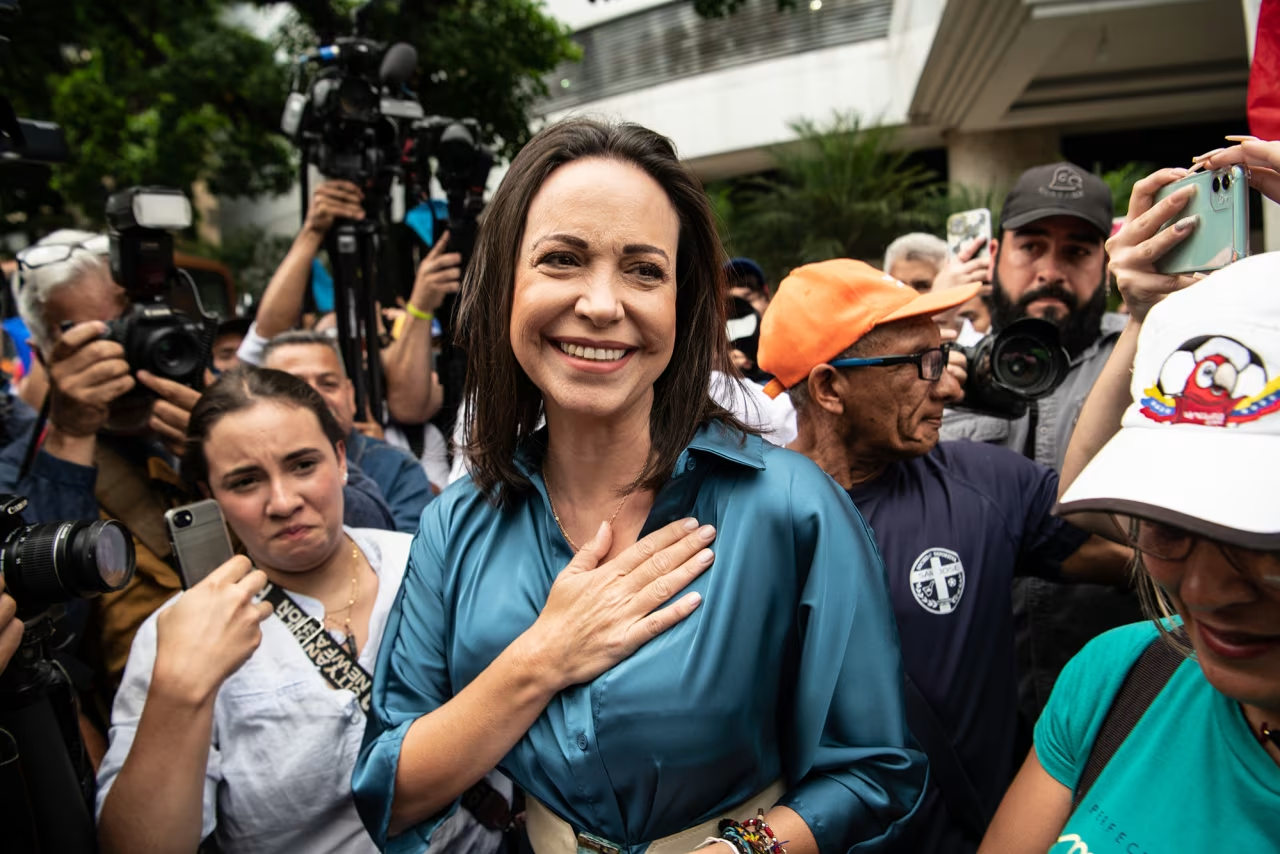
Venezuelan opposition leader María Corina Machado was awarded the 2025 Nobel Peace Prize in October last year for keeping “the flame of democracy burning amid a growing darkness.”
She was awarded the prize “for her struggle to achieve a just and peaceful transition from dictatorship to democracy,” the Norwegian Nobel Committee said at the time. In a statement accepting the award, Machado said the prize belonged to the people of Venezuela.
She also dedicated the prize to US President Donald Trump, telling CNN that “he deserves a Nobel Peace Prize because of (the) incredible events that are taking place currently in the world.”
In addition to being a staunch proponent of democracy and a vocal supporter of Trump, Machado is also an avowed capitalist who previously ran on a campaign to privatize most Venezuelan public assets, including in the sectors of health, oil and education.
In an interview with CNN before Venezuela’s contested 2024 elections, she repeatedly called for the country’s markets to be opened, saying: “we need to create conditions that are so competitive, so attractive that international resources will be invested in a country, despite what happened in the previous regime.”
Yesterday, Machado said that, following the US’ capture of ousted Venezuelan President Nicolás Maduro, her country “will be the United States’ main ally in matters of security, energy, democracy and human rights.”
In an interview with Fox News the same day, Machado said she hadn’t spoken to Trump since October, after her Nobel Peace Prize win.
She thanked the US leader for “the historical actions he has taken against the narco-terrorist regime,” saying that January 3, when Maduro was captured by the US, “will go down in history as the day justice defeated tyranny.”
CNN’s Christian Edwards, Char Reck, Billy Stockwell, Stefano Pozzebon, Rocío Muñoz-Ledo and Lex Harvey contributed to this reporting.
European leaders back Denmark in face of renewed US interest in Greenland

Leaders from major European powers have just expressed support for Denmark and Greenland in a joint statement, saying the Arctic island belongs to its people, following renewed interest by US President Donald Trump in taking over the Danish territory.
“Greenland belongs to its people. It is for Denmark and Greenland, and them only, to decide on matters concerning Denmark and Greenland,” said the statement by leaders of France, Germany, Italy, Poland, Spain, Britain and Denmark.
The leaders said that security in the Arctic must be achieved collectively with NATO allies, including the United States.
Trump has said repeatedly he wants to take over Greenland and told The Atlantic magazine on Sunday: “We do need Greenland, absolutely. We need it for defense.”
A US military operation at the weekend, which led to the capture of Venezuela’s President Nicolas Maduro has further rekindled concerns among Washington’s NATO allies that Greenland might face a similar scenario.
Some context: Greenland is the world’s largest island with a population of 57,000 people. It is not an independent member of NATO but is covered by Denmark’s membership of the Western military alliance.
The island’s strategic location between Europe and North America makes it a critical site for the US ballistic missile defense system. Its mineral wealth also aligns with Washington’s ambition to reduce reliance on Chinese exports.
Venezuela's new acting leader Delcy Rodríguez and her relationship with the US

The former vice president of Venezuela, Delcy Rodríguez, was formally sworn in as the country’s acting leader yesterday.
The 56-year-old has spent more than two decades as one of the leading figures of Chavismo, a socialist ideology founded by influential leftist leader Hugo Chávez, which also values Venezuela’s sovereignty as something to be protected from “imperialist” powers.
Despite her staunch support of the Chavismo movement and her hard-line rhetoric about the US following its capture of ousted Venezuelan President Nicolás Maduro and his wife Cilia Flores on Saturday, she has seemed to soften her language regarding the country in the days since.
Initially, Rodríguez accused the US of “kidnapping” her country’s leader and said that violations of international law were committed, accusing US forces of having “savagely attacked” Venezuela’s territorial integrity.
But on Sunday, she extended an invitation to the United States government to collaborate on an “agenda of cooperation,” saying that Venezuela will “prioritize” moving toward “balanced and respectful international relations” with the US and the region.
Yesterday, US President Donald Trump did not say whether he has yet spoken directly to Rodríguez, but told reporters that US Secretary of State Marco Rubio has been speaking with her in fluent Spanish on the phone and that their “relationship has been very strong.”
CNNE’s Mauricio Torres, CNN’s Helen Regan and Kit Maher contributed to this reporting.
What to know about Venezuela’s oil — and the early odds of the US reaping the benefits Trump is promising
US Energy Secretary Chris Wright is expected to meet this week with American oil executives as President Donald Trump touts Venezuela’s vast oil resources as a windfall from his decision to remove President Nicolás Maduro from power.
Trump said yesterday US companies can rebuild Venezuela’s dilapidated oil infrastructure in about 18 months, a timeframe drastically at odds with many industry analysts’ estimates.
CNN’s David Goldman outlines the issues here:
Here’s what we know about the US plan:
- Big Oil is wary: US oil executives likely aren’t champing at the bit to invest in Venezuela, industry sources tell CNN. The troubled country’s oil industry is in shambles, and the political situation in the wake of Maduro’s removal is murky. Then there’s Venezuela’s recent history of nationalizing US oil companies’ assets: ConocoPhillips is still trying to recover $12 billion and ExxonMobil nearly $2 billion for assets seized in 2006, according to Reuters.
- Trump says 18 months, experts say years: Despite the president’s optimistic outlook, analysts estimate rebuilding Venezuela’s oil infrastructure could take more than a decade. Just maintaining the country’s current output would require $53 million over 15 years, and increasing capacity to 1990s levels would take $183 million through 2040, consulting firm Rystad Energy said Monday.
- Ongoing blockade: The US military is continuing to enforce a blockade of sanctioned vessels entering and leaving Venezuela. Secretary of State Marco Rubio says the move “allows us to exert tremendous leverage over what happens next” in Venezuela by targeting how the regime generates revenue. Rubio and the energy secretary are leading the effort to engage the US oil industry on Venezuela, a senior White House official told CNN.
- Tankers seized: The US has seized multiple vessels since Trump ordered the blockade last month. As for the oil seized, Trump has said, “We’re going to keep it.” And the US is maintaining its blockade, including pursuing sanctioned oil tankers that have attempted to evade capture, according to four sources.
- How much oil is at stake: Venezuela has the largest proven oil resources on Earth – about 20% of global reserves as of 2023. But its potential far outweighs its actual output, as it produces less than 1% of global crude production.
CNN’s David Goldman, Natasha Bertrand, Alayna Treene, Kylie Atwood, Zachary Cohen and Avery Schmitz contributed reporting.
How did countries react at the UN Security Council meeting yesterday?

Top diplomats at a UN Security Council meeting yesterday were largely critical of the US operation to capture Venezuelan President Nicolás Maduro.
Criticism came from several quarters – Latin American countries, with the notable exception of Argentina, traditional US adversaries Russia and China, as well as less powerful countries like Pakistan and Uganda. Even Washington’s European allies were reluctant to throw their full support behind their longtime security partner.
What did the US say? Mike Waltz, the US envoy to the UN, characterized the move as a “law enforcement operation,” calling Maduro a “narco-terrorist” who was “responsible for attacks on the people of the United States, for destabilizing the western hemisphere and illegitimately repressing the people of Venezuela.”
What did Venezuela say? Caracas’ UN envoy Samuel Moncada said Maduro’s capture was driven by the US’ desire to access Venezuela’s resources, and threatened both Venezuela’s sovereignty and “the credibility of international law”.

Who condemned the US operation? Chile, Brazil, Mexico, Cuba, Colombia all condemned the US’ actions. Brazil’s UN envoy said the operation “crossed an unacceptable line” and violated international law. Meanwhile, Russia’s envoy to the UN warned that Washington’s actions could generate “fresh momentum for neocolonialism and for imperialism.” Pakistan’s envoy cautioned that the operation could set “dangerous precedents.”
Who backed the US? Argentina, led by Trump ally Javier Milei, backed the US’ “decisive action” in Venezuela while Washington’s European allies offered a more tempered approach. James Kariuki, the UK’s ambassador to the UN, said London saw Maduro’s claim to power as “fraudulent” and would push for a peaceful transition towards a legitimate government, but also reiterated the importance of international law. France struck a similar tone, saying that the US operation “chips away at the international order”.
Colombian President Gustavo Petro accuses US of colonialist ambitions in Latin America

Colombian President Gustavo Petro has warned that US President Donald Trump is aiming to turn Latin American nations into colonies of the US.
“If you read the first few paragraphs of the national security policy you will understand that the Monroe Doctrine aims to make sovereign Latin American nations colonies again,” wrote Petro in a post on X.
“That completely goes against international law. It’s the same doctrine around living space that Hitler used, and it caused two world wars,” he added.
In a separate post, Petro called on US voters to “help construct an international democratic order.”
“It doesn’t matter what color, party or state these people are from, they need to act, world peace and the future of human existence are in danger,” he added.
Analysis: Why the US strike on Venezuela plunges Greenland and NATO into uncertainty

Amid increasing concerns that Greenland, a vast Arctic territory ruled by Denmark, is still being coveted by the Trump administration, the Danish prime minister has delivered a stark warning to the White House.
In nationally televised remarks, Mette Frederiksen reminded Danes that she had already “made it very clear where the Kingdom of Denmark stands, and that Greenland has repeatedly said that it does not want to be part of the United States.”
But she also warned of the consequences of US military action to seize Greenland – something US President Donald Trump has pointedly refused to rule out.
“But I also want to make it clear that if the US chooses to attack another NATO country militarily, everything stops, including NATO and thus the security that has been provided since the end of World War II,” she added.
A Danish lawmaker has described US President Donald Trump’s latest comment about how the US needs Greenland as “very frankly stupid.”
Here’s what Anders Vistisen, who is a member of the European Parliament, told CNN’s Erin Burnett:
It is a serious and widely shared concern among NATO allies that the Greenland issue has the potential not only to anger and humiliate a longtime US partner, but also to fracture the Western military alliance as pressure from Washington escalates.
Late last night White House deputy chief of staff for policy Stephen Miller reiterated those claims that “Greenland should be part of the United States,” but he rejected that military force would be necessary to acquire it.
“Nobody’s gonna fight the United States militarily over the future of Greenland,” Miller said on CNN’s “The Lead with Jake Tapper.”
When pressed whether military intervention is off the table, Miller instead questioned Denmark’s claim over the Arctic territory.
You can read the full analysis here.
Analysis: What Maduro's capture means for China and Taiwan
China and Venezuela have maintained close relations for decades, forged by a shared political ideology and mutual distrust of a world led by the US.
The bulk of Venezuelan oil exports flow to China, and Chinese companies finance extensive infrastructure projects and investments across the country, with Beijing lending billions to Caracas in recent decades.
Trump’s move has appeared to upend that relationship, at least for now, raising questions over China’s preferential access to Venezuelan oil and the future of its political and economic influence in the wider region.
Chinese social media has erupted with discussion of the implications. If the US can snatch a leader in its backyard, many ask, why can’t China do the same? By late Monday, topics linked to Trump’s capture of Maduro had received more than 650 million impressions on Weibo, with many users suggesting it could offer a template for Beijing’s potential military takeover of Taiwan.
But Beijing has struck a different tone in public statements. It has denounced Maduro’s capture, condemning Washington for behaving like the world’s policeman, and calling for the ousted leader’s immediate release.
Subscribers can read the full analysis here.
Venezuela’s opposition leader vows to return home
Venezuelan opposition leader María Corina Machado vowed to return home “as soon as possible” in an interview with Fox News yesterday.
Machado, who is under a decade-long travel ban, had been in hiding for more than a year but traveled to Oslo, Norway in December to accept the Nobel Peace Prize. She left Oslo last month.
In the wake of the capture of ousted leader Nicolas Maduro, Trump said Machado “doesn’t have the support within or the respect” to lead Venezuela and has repeatedly said that the US is in charge of the country.
Machado said she last spoke with Trump on October 10, when her Nobel Peace Prize win was announced.
Senior White House aide Stephen Miller has also dismissed calls for the US to install Machado as president.
The US has instead been working with Maduro-ally and acting President Delcy Rodríguez, who has vowed to cooperate.
What’s next for Venezuela and its ousted leader Nicolás Maduro?

Venezuela remains in turmoil days after leader Nicolás Maduro and his wife Cilia Flores were captured by US forces from their military fortress in Caracas.
In New York yesterday, Maduro and Flores pleaded not guilty to drug and weapons charges in their first court appearance, in which Maduro declared: “I am still president of my country.”
Their next hearing is scheduled for March 17. Neither Maduro nor Flores are immediately seeking bail or release.
Back in Venezuela, Maduro-ally Delcy Rodriguez was sworn in as acting president yesterday, though President Donald Trump has repeatedly said he is in charge, and has not ruled out broader military intervention in the South American country if the regime does not cooperate.
Here’s what may come next:
- Miller outlines US position: White House deputy chief of staff Stephen Miller characterized US involvement in Venezuela as an “ongoing military operation,” even as the administration has contended that capturing Maduro was a law enforcement action. He told CNN the US is using its control of the Venezuelan economy as leverage to ensure its new leadership does what Trump wants. He also said the White House has not ruled out future indictments for Venezuelan officials.
- What’s the US plan? Senate Majority Leader John Thune said questions on the timeline for US control over Venezuela could be answered in the “next few days,” while other lawmakers have expressed doubt that Trump has a clear plan for Venezuela.
- Machado vows return to Venezuela: Opposition leader María Corina Machado said she plans to return to Venezuela ASAP. She said she hadn’t spoken to Trump since October. Trump and other US officials have dismissed calls to install Machado as president, claiming she lacks legitimacy, drawing criticism.
- The oil angle: US Energy Secretary Chris Wright will meet with oil executives this week to discuss Venezuela. Trump has projected it will take less than 18 months for oil companies to rebuild Venezuela’s energy infrastructure. The US is also making plans to intercept a Venezuela-linked oil tanker that Russia has claimed jurisdiction over, sources told CNN, aiming to enforce its blockade off Venezuela’s coast.
- Broader threats: Trump has issued threats and warnings to other countries that he deems uncooperative. He said he could take military action in Colombia, told Mexico to get its “act together” on drugs, and said the US “needs Greenland.”
Here's what happened overnight in Caracas

Gunfire was heard overnight near the Miraflores presidential palace in the Venezuelan capital Caracas — a city on edge with security services on heightened alert following the US attack and capture of President Nicolás Maduro.
Video verified by CNN shows anti-aircraft fire over Caracas amid reports of confusion between security units in the capital.
A Venezuelan ministry later said police had fired at drones that were “flying without permission” and that “no confrontation occurred.”
Here’s what we know:
- Reports of gunfire: One resident, who spoke to CNN on condition of anonymity, said they heard gunfire close to Urdaneta Ave near the Miraflores presidential palace.
- Videos: Video verified by CNN shows anti-aircraft fire over the Caracas. In separate video verified by CNN audible gunfire could also be heard.
- What authorities said: Venezuela’s Ministry of Communication and Information said police fired at drones that were “flying without permission.” The ministry added that “no confrontation occurred.”
- A “misunderstanding”: Discussions between Maduro-linked paramilitary groups and heard by CNN indicate the gunfire was related to confusion between different security groups operating near the Miraflores presidential palace. A member of one of these groups can be heard calling for backup and that “several shots were heard.” Later, the speaker said that a drone flying in the area was fired upon by members of the Miraflores Police and palace security.
- What is the situation now? The Ministry of Communication and Information said “the entire country is completely calm,” though it did not say who might have been flying the drones. The paramilitary groups also indicated the situation was under control.
- What has the US said? A White House official told CNN they were closely tracking the reports of gunfire out of Venezuela, but noted that “the US is not involved.”
Here's what comes next for Maduro and his wife
During the first hearing in New York in the case against ousted Venezuelan President Nicolás Maduro and his wife, Cilia Flores, the defendants professed their innocence and accused the US government of abducting the two from their home.
Both pleaded not guilty to the drug and weapons charges against them and chose, for the time being, not to fight their detention.
The historic court appearance marks the start of what could be a lengthy litigation process as they will likely fight the legitimacy of their military capture.
Maduro’s attorney Barry Pollack said he plans to file several motions challenging the indictment and Maduro’s controversial arrest by US operatives, calling it a “military abduction.”
Pollack also said Maduro has privileges and immunity tied to his office as the head of a sovereign state.
Maduro and Flores also asked for a “visit” with the Venezuelan consulate. Under US law, foreign nationals detained in the US are entitled to consular notification and access to consular resources. It’s unclear what exactly that would look like.
Attorneys for Maduro and his wife did not make a pitch for their release in court Monday but said they will make a formal bail application down the line.
The next hearing in the case is scheduled for March 17.
What Trump and his administration officials are saying about Venezuela

President Donald Trump and several other key members of his administration spoke last night as the United States determines its next move on Venezuela.
After ousted President Nicolás Maduro and his wife appeared in a Manhattan courtroom yesterday, the US president said he is in charge of the South American country.
Here’s what the administration is saying:
- Trump told NBC News he considers himself in charge of Venezuela. He suggested the US could launch a second military operation if Delcy Rodríguez, who is now the acting Venezuelan president, stops cooperating but said he doesn’t think it will be necessary. He also projected it will take less than 18 months for oil companies to rebuild Venezuela’s energy infrastructure.”
- Defense Secretary Pete Hegseth said the US operation included nearly 200 US personnel on the ground in Caracas. He also said Maduro didn’t know the troops were coming “until about three minutes before they arrived.”
- US Department of Energy Secretary Chris Wright will meet with oil executives later this week to discuss US companies once again standing up drilling for oil in Venezuela, the department said.
- Senior White House aide Stephen Miller characterized the US involvement as an “ongoing military operation,” even as the administration has contended that capturing Maduro was a law enforcement action. He said the US is effectively using its control over the Venezuelan economy as leverage to ensure that its new leadership does what the Trump administration demands.
CNN’s Ella Nilsen, Adam Cancryn, Haley Britzky and Kit Maher contributed reporting to this post.